
The Education Process
Production and Process in education

When I was an undergraduate, I attended a philosophy conference at University of Oklahoma in Norman, OK. I did a paper on sense perception and language and argued with the keynote speaker over whether utilitarianism was a coherent philosophy of ethics. One of the other papers, though, has long stuck with me. It asked whether an external hard drive contained knowledge.
There is a larger philosophical debate about what knowledge even is that I will not get into today. The baseline definition is “justified, true belief” and everyone who has ever thought about it has found dozens of objections and edge cases that get grouped under the name “Gettier problems” after Edmund Gettier. But most of those objections hinge on the question of tensions between justified and true. This paper hinged on the question of belief.1
In order to know something, a person must believe it. It must be in the set of propositions a person believes. If the propositions the person believes are not held in the mind of the person, but are instead embedded in the binary code of the external hard drive, does the person know the propositions? The person giving the paper concluded that they did, so long as the person encoded the hard drive and that if they accessed the hard drive they would still believe the propositions. I’m still not convinced.
Forget Me Not
The argument, as I recall, went that notes still constitute knowledge, they are just a technological augment to knowledge. They point to information that is already contained in the memory, and it doesn’t matter whether the pointers are mnemonic devises, written notes, or a computer. In this he followed, though ultimately disagreed with, Plato’s argument in Phaedrus that writing did not increase knowledge, but substituted a reminder for memory.
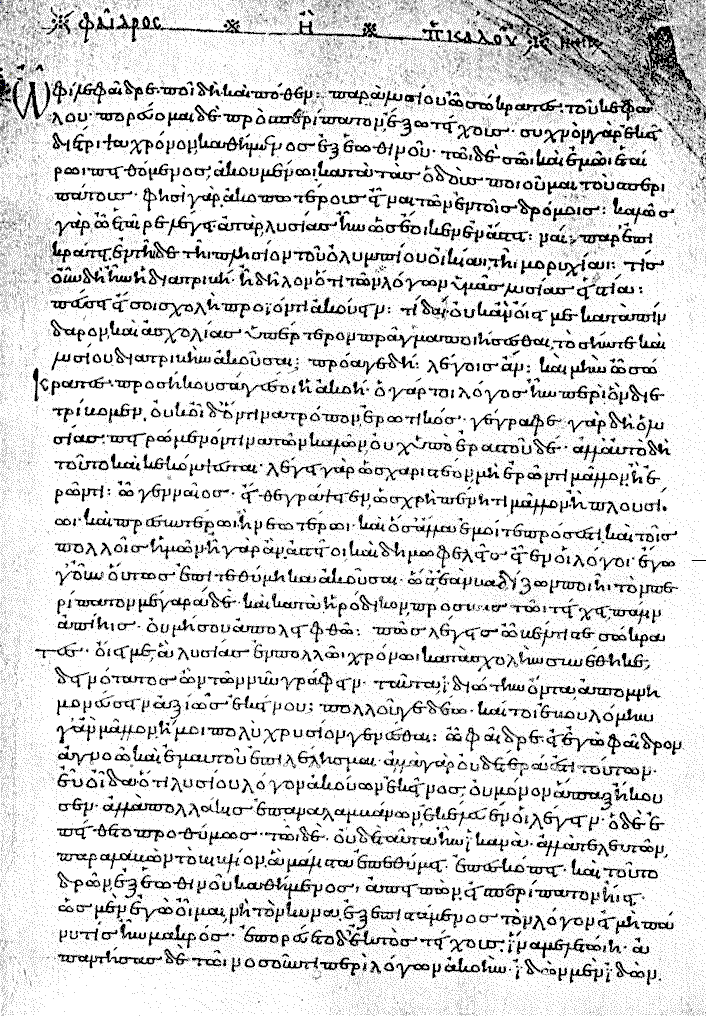
Socrates viewed writing as a mixed blessing, at best. The first requirement of philosophy is a good memory, because the ability to combine ideas, to discuss and debate, and to change with the flow of the conversation are the prerequisite skills of the philosopher. One cannot pursue truth, beauty, and good if one is permanently infused upon the page. Writing, rather, gives the pretense of knowledge since it is entirely static.
Indeed, if culture is the broader discussion of what the true, beautiful, and good are, then we have already discussed that philosophy is an unending conversation that each generation must be acculturated to. If the external hard drive consists of pointers to information, the person using the drive must already have the information in their mind for the pointers to work -otherwise it is just gibberish. A dangling pointer. The array of knowledge necessary for the hard drive to work must already have been copied to the user via other means. We typically call those means “education,” but whatever we call them, the hard drive is not knowledge, nor are your notes. What you know are the things in your memory, of which writing can point you to things you had perhaps forgotten, but because writing can remind you it also becomes easier to forget. And having forgotten, the pointers might not be clear enough for you to reconstruct the knowledge later in your mind.2
The AI Monster
It’s been near 30 years and this paper is never far from my mind -I hope the author has gone on to great things, because obviously it was a good paper even if it was wrong. But the paper is brought back to mind in recent days because of the advent of AI in universities. The question faculty are asking is what we are doing now since the AI knows everything. Does this mean our only value is teaching skills? In a world with YouTube tutorials for everything, are even skills valuable?
Of course I’ve already addressed part of this. A lot of what we do is inculcating certain professional norms and knowledges into students so that they actually know the things necessary to engage the educated culture. The computer doesn’t know things, it just points to things the user knows. Substituting AI for actual knowledge is like substituting Cyrano de Bergerac for Christian.
The result is Socrates’ pretense: a person who sounds like they know things, but actually doesn’t. In the end, they are not actually an educated person and no amount of skilling or augmenting is going to make them act like an educated person. The best they can do is fake it.
Christian -or in the movie, Chris -can speak the words, but because he lacks the requisite knowledge and character formation he doesn’t know which words to say and which to ignore. He doesn’t know how to say them, and he needs Cyrano/CB do read him the stage directions. The result is cringe. Funny cringe, but cringe.3 He hasn’t had the necessary soul formation.
The problem runs deeper than just the lack of knowledge, though. The person dependent on AI or CB is also being led around by the nose. They don’t know what they are doing, they don’t know where they are going. And they couldn’t explain what they are doing. Their actions lack all internal justification except “it’s what the computer told me to do.” This is an anti-educational development, because the purpose of liberal education is to make people who are capable of exercising liberty without destroying themselves or the world around them. It is instead a Brave New World system that makes willing slaves, and worse, willing Deltas who think, because they can speak fluently, they are actually Betas.
Reading Between the Lines of Code
Knowledge is not contained in books or code. The code and the books are pointers to where the knowledge is contained, which is in the minds of the people who read and write the books and codes. Every bit of writing relies on thousands of cultural touchstones and formal features to communicate, and without that surrounding conversation it is impossible to understand the full meaning of the writing.4 The problem for humanity, lovingly also described as the pretense of knowledge by Hayek, is that all the necessary knowledge rarely resides in a single person, and for a large project it never does. We are trying to combine knowledges with writing and organization and tradition and culture as coordinating tools and these are imperfect at best.
And it gets worse. As our society becomes more and more complex, the amount of knowledges that are needed increases geometrically -because it isn’t just that we need to know one more thing, we need to know that one more thing and how it interacts with everything we already know. Rapidly, the necessary knowledge exceeds what a human memory can hold and in order to function humans must internalize massive amounts of knowledge as just part of the culture and beliefs of the organization. Again, we typically call this “education” or “indoctrination” or “new employee orientation.” It is necessary to get this knowledge of the world embedded at a subconscious level so that we can get on with the actually hard part of labors. As we become more capable, more an more information gets subsumed in that body of tacit knowledge. AI promises the ability to offload some of that tacit knowledge burden to the machine, but I doubt that it will work. The hard drive doesn’t hold knowledge. If the tacit knowledge never gets subsumed in the person, they never reach the higher capabilities and are forever stuck tethered to machine pointers.
And still it gets worse. I’m willing to think that a person who has already been educated and reached the point where they have a large body of tacit knowledge could find AI useful for accelerating their entry into a hitherto unfamiliar field. They could also use the AI pointers to make explicit what had previously been tacit information -such as finding a cite the details of which the user had forgotten but the existence of which they knew. But the process of education, from explicit to tacit, would be disrupted by skipping the learning the step in favor of AI Pointers.
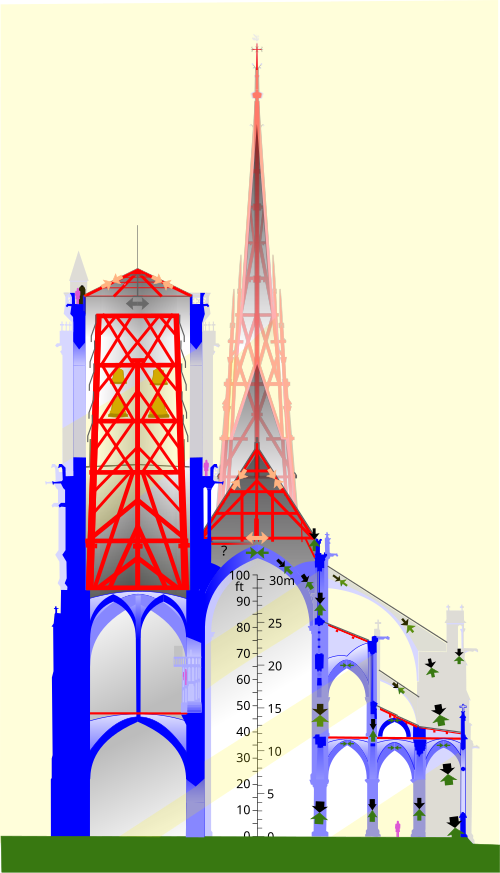
All the tacit knowledge, all the esoterica, has to be passed on to the next generation and it cannot be passed on in writing because the writing is the pointers to knowledge, not knowledge itself. The knowledge comes from engaging the writing and the process of learning and growing and forming. AI removes all the superstructure and probably most of the substructure of education. It’s like trying to have Notre Dame without the buttresses and spandrels.
The Relationship of Man and Knowledge
Ultimately, knowledge exists in a relationship with itself and its users. Knowledge is held in the processes by which it is shared and developed -to which written work and AI can assist in the process, but it cannot replace it without destroying the knowledge network it relies upon. Much like writing freezes language and thought, AI will do the same. Without the surrounding experiences and work, knowledge becomes just data that cannot be interpreted, let alone shared with others.
I think that’s enough for today. Perhaps another time I’ll tackle how and why I think we got into this situation.
My view has long remained that most epistemologists are making their life too difficult by requiring knowledge to be true. It is obvious to me that people can know false things. It’s called being wrong, and it’s a fairly common experience for humanity. Here’s Tommy Lee Jones explaining it. That puts me largely in the Williamson “Knowledge First” camp, though I think Sosa’s Aptness definition is interesting.
I tell my students to notate and cite twice as much as they think they need to because after 30 years I’ve long since learned that notes I took in college are often entirely meaningless to me now. There’s a couple things I wrote in grad school that I don’t know if I miscited them (they are cited, and not quotes, but the underlying source doesn’t read that way to me now -so I don’t know if I just read the source differently back then) or if they were original thoughts.
More people should try acting just realize how hard it actually is. When you watch a movie and see deep emotion on the character’s face, or see how they move with weariness or injury, remind yourself that the actor isn’t actually experiencing those emotions or that weariness the same way the character is. They are drawing on their own souls to find equivalent experiences that they can relive or repeat -depending on the method -to bring out the performance of the character. Education is basically the same thing -the provision of experiences and encounters such that student behaves as the educated man would. It’s a system deeply embedded in virtue habituation, which is why technocratic utilitarian emphasis on skills and pecuniary return on investment is so toxic to it.
I confess I dislike the implications of this argument because I’m a Protestant, and I really like the sufficiency of the scriptures and I don’t want to give the Orthodox the satisfaction of being right, but the argument for esotericism in written language is pretty compelling.